PHS Monday Seminar Featuring Amy Schultz, PhD, MS
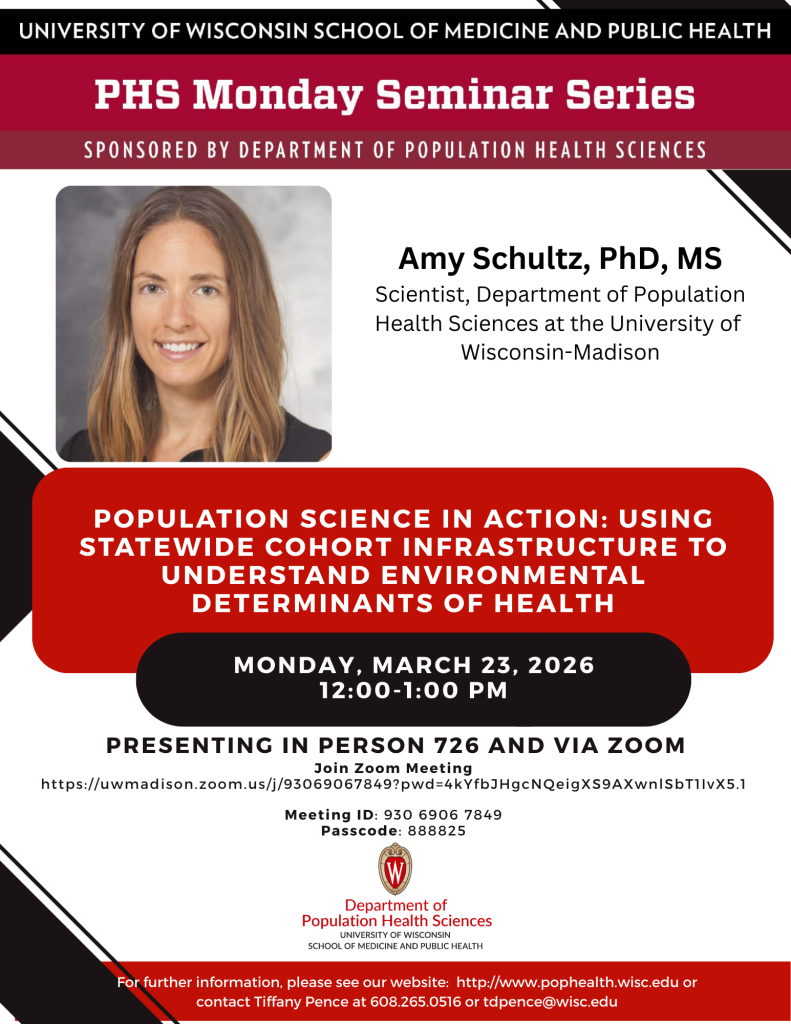
PHS WARF Room 726 and Zoom
Bio: Amy A. Schultz, PhD, MS, is a Senior Scientist in the Department of Population Health Sciences at the University of Wisconsin–Madison and an environmental epidemiologist studying how environmental exposures—including PFAS, pesticides, metals, and air pollution—shape population health. Her interest in environmental health grew from early professional experiences in natural resource management with the U.S. Bureau of Land Management and teaching in the Mississippi Delta, where she witnessed firsthand how environmental and structural conditions influence health in communities. Her work integrates biomonitoring, geospatial exposure assessment, and epidemiologic methods to identify exposure pathways and evaluate environmental drivers of chronic disease. Her research explores the intersection of environmental exposures with cardiometabolic outcomes, biological aging, and Alzheimer’s disease biomarkers. Dr. Schultz previously served as Associate Director of the Survey of the Health of Wisconsin, a statewide population-based cohort that supports environmental health research and public health surveillance. She currently serves as co–principal investigator of a CDC-funded biomonitoring study of pesticides and metals among rural residents and led the first statewide human biomonitoring study of PFAS in Wisconsin. Her work is grounded in long-standing partnerships with the Wisconsin State Laboratory of Hygiene and the Wisconsin Department of Health Services to advance exposure assessment, detect emerging contaminants, and translate scientific findings into public health action.